There’s a common question I get asked: what exactly do you do?
The honest answer is… a few things. I’m a documentary photographer. I host and produce podcasts. I write.
But the real answer is that I bring these together to tell fuller, more human stories.
Because one medium on its own can only go so far.
– A photograph can stop you in your tracks. – A conversation can reveal what sits beneath the surface. – Well-crafted words can give context, clarity, and lasting meaning.
When these come together, something more powerful happens, stories that feel authentic, layered, and genuinely reflective of the people and communities at their heart.
Much of my work has been alongside charities, community organisations, and purpose-driven projects. The aim is always the same: to represent people honestly, with care and respect, and to create media that doesn’t just look good, but actually connects.
That might mean documenting a project over time, producing a podcast that gives people a voice, or creating written pieces that help audiences understand why the work matters.
I’m particularly interested in collaborations where there’s a story worth telling, especially those rooted in community, culture, or positive change.
If you’re part of an organisation, business, or project and you think there might be something we could create together, I’d genuinely love to hear from you. No hard sell. Just a conversation to see what’s possible.
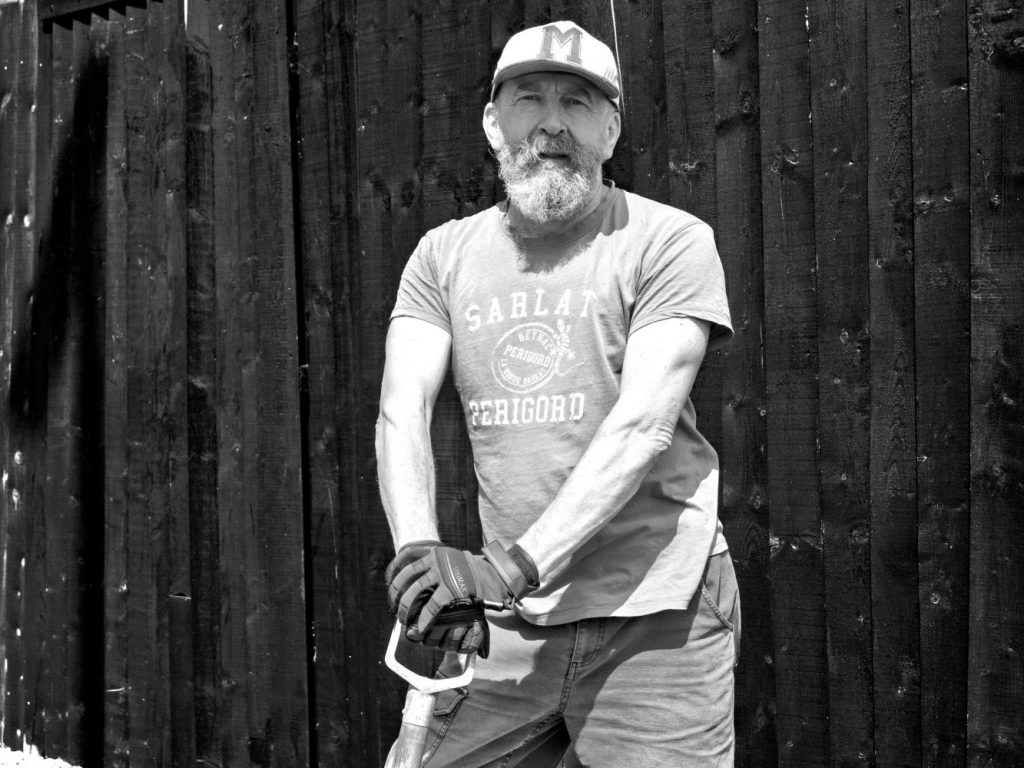
“It was, if I remember, late summer 2024,” said Dean. “I was walking through the town of Stoke-upon-Trent when I bumped into Liz Perry who was sitting on a bench. She told me about some money that had become available to help brighten up my town. It was called The Stoke Accelerator Green Space Fund. Liz asked if I’d like to be involved.”
A chance conversation turned into the formation of a little group that took the name ‘E Terris Dare Artem’, which means ‘to produce beauty from the earth’, it’s the motto of the town of Stoke-upon-Trent, explained Dean.
The group put in a bid for the funding and were successful.
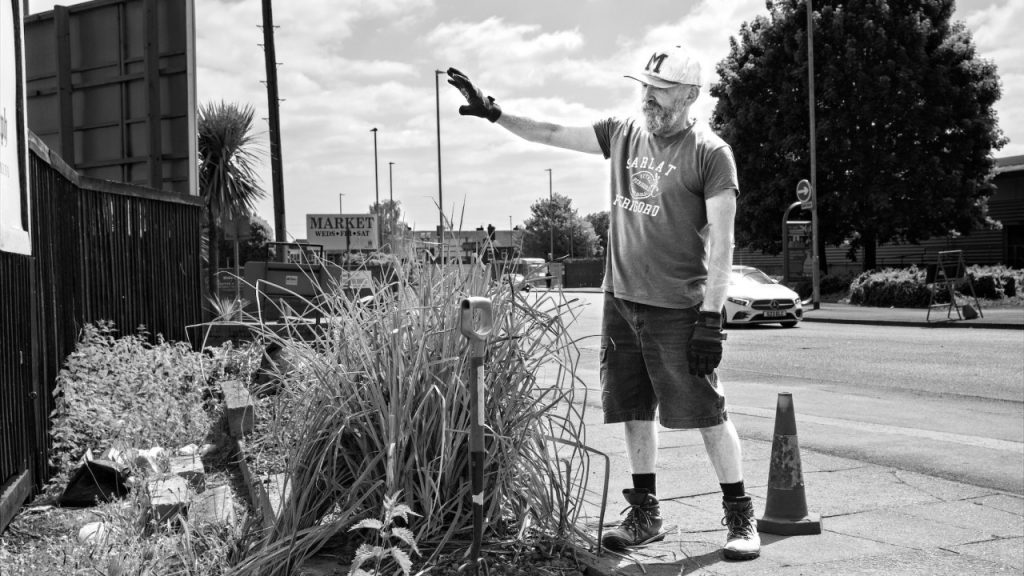
“We walked around the town and targeted any number of abandoned and semi-derelict sites which with care and consideration could be turned into colourful points of interest that would both welcome visitors to Stoke-upon-Trent and be places of rest and relaxation for residents and workers.”
A period of investigation then started as the group tried to find out who owned the various small plots they wished to show a bit of love to.
Dean continued: “Once ownership and permissions were obtained we were able to begin work. Due to the time it took to track down owners we missed the autumn planting of spring bulbs, then we experienced one of the driest, hottest and brightest starts to spring on record. This hampered opportunities for quick-fix planting as available ground was compacted, parched and denuded therefore extremely challenging to cultivate.”
When I met with Dean he was valiantly battling on with digging out and prepping a dry, stony strip of land under a billboard on Fleming Road.
“Our immediate concerns relate to watering as we have no access to irrigation,” said Dean. “We also need to seriously consider how ongoing maintenance is to be resolved.”
You’ve got to admire the group’s determination and applaud the effort they’re putting in.
“The onus on this project is to provide safe, friendly and visually beautiful sites deserving of the residents and visitors to our town,” said Dean.
“We aim to turn Stoke-upon-Trent from grey, to green and blue and yellow and red and orange, and in so doing restore pride and optimism to the town at grassroots level.”
“My nickname is Birdman. So, I use birds in all of my work. For me, birds can travel the world without thinking of borders, you know? Something I don’t have the luxury of.” Semaan Khawam.
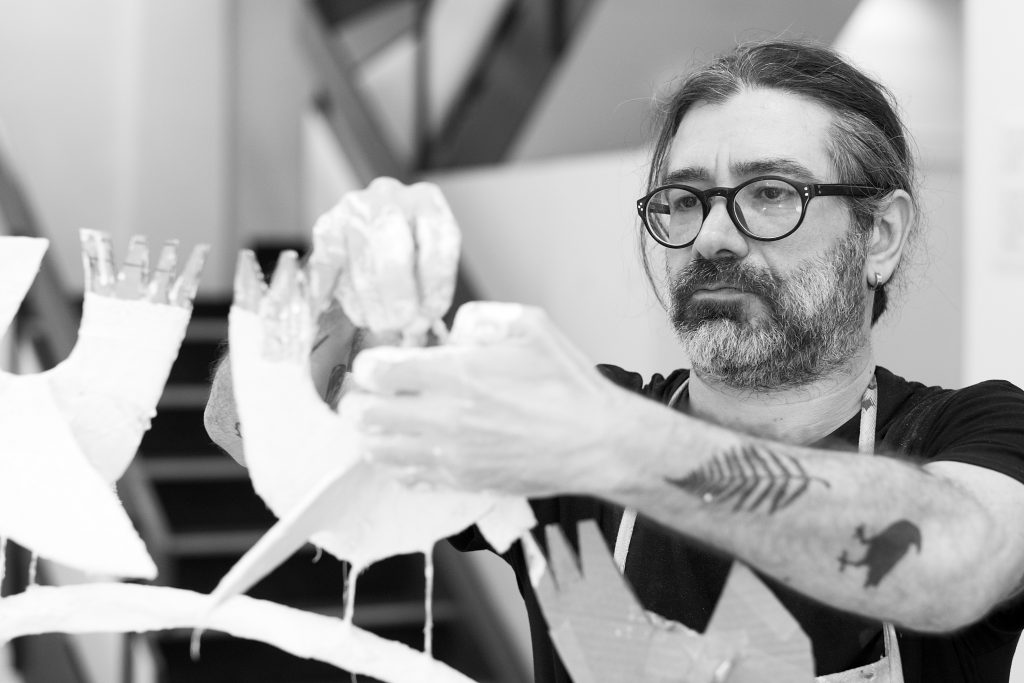
Semaan Khawam is artist-in-residence at Allison Lochhead’s ‘Art for Peace’ exhibition, showing at Appetite’s Astley Walk arts space in Newcastle-under-Lyme.
Allison Lochhead’s artwork presents discarded shoes cast in iron, books burned, and columns of rubble stacked high, they tell a story of war and migration as well as the destruction of cultures and histories.
Born in Syria, Semaan tells me he’s seen a lot of death and destruction in his own country too. His family fled Syria in the 1980s, settling in Beirut, Lebanon.
“I’m a refugee in a sense,” said Semaan, “but not when I leave the Middle East. I feel I’m more of a refugee in the Middle East. Not in Europe, I feel like here it’s more like a home to me.”
Unable to return home to Syria, art is Semaan’s passport to places he’s found more welcoming.
“I work with garbage. I up-cycle and recycle, because also there’s a big garbage crisis around the world, garbage in the literal sense and in the philosophical sense. In every sense, there’s a lot of garbage we’re surrounded by, garbage ideas, garbage practice.
“The world is not a safe place right now. It feels like a dump. There’s a lot of hate and a lot of garbage! So I try to take it all, put it all together, and turn it into something peaceful, an art piece.”
Semaan tells he finds the freedom of birds alluring and inspiring. Birds feature extensively in his artwork.
“When birds migrate, they don’t leave a country behind, they don’t leave home, they can always come back. I like that, that idea. Wherever I leave a sculpture around the world, I feel like it’s a nest for me, where I can come back and visit. I don’t want to stay. I don’t want to become rooted. I’d rather be free, like the birds.”
As we talked, Semaan was working on an elaborate sculpture made of wires and plaster, and yes, garbage too. The piece featured a human torso, arms raised high, and a branch full of birds, doves.
“This piece is called The Flying Instrument of the Mind,” said Semaan.
“Sometimes you feel so heavy, with your head, and the restrictions, and the way life has been treating you. So maybe this instrument can help you fly. You know, if I can harness the power of these birds.”
We agreed, many people needs wings to lift them higher.
We chatted with FRONTLINEdance Ltd a couple of weeks ago about their work across North Staffordshire. They now have news of a special project to mark the Queen’s Jubilee, and they’re looking for dancers of all ages and abilities to take part.
PODCAST: 5 minutes
Rachael Lines, creative director, said: “2022 marks 70 years since Her Majesty the Queen ascended the throne, and FRONTLINEdance has been awarded some funding to host a creative and cultural event to celebrate.
“We are creating an event called ‘With Soundness of Heart’, which is an inter-generational inclusive performance project, and this weekend is when it all starts.”
The project is now looking for dancers to take part. The first creative meet-ups for interested participants take place this weekend at the Potteries Museum and Art Gallery. Further rehearsals take place on 11th and 18th June. The finished performance will take place in Hanley on 25th June.
“We always open our doors to non-dancers as well as professional dancers,” said Rachael. “This project does exactly that. It welcomes those with previous dance experience and those completely new to dance. The performance will be co-created. It’s going to be very inclusive, and very accessible to people with disabilities and long-term health conditions as well, because that’s who we are.”
Can’t dance? Won’t dance? There’s also opportunities for spoken word artists to get involved, and the event also needs volunteers too.
Funding has come from Arts Council England’s Jubilee Fund, Staffordshire Community Foundation, and Stoke-on-Trent BID’s Let’s Create Fund.
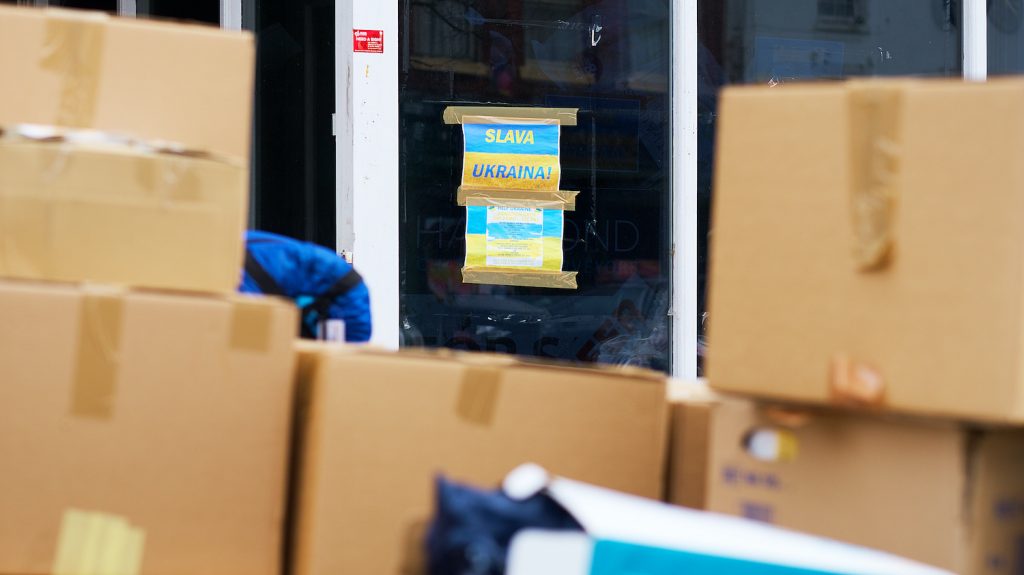
It’s day twelve of Putin’s War. Two million people have fled Ukraine, crossing the borders to neighbouring countries, seeking safety and refuge. Thousands more have been displaced internally. Yet more are too frightened or too frail to move from their homes as the bombs keep falling.
And people across North Staffordshire are moved to help.
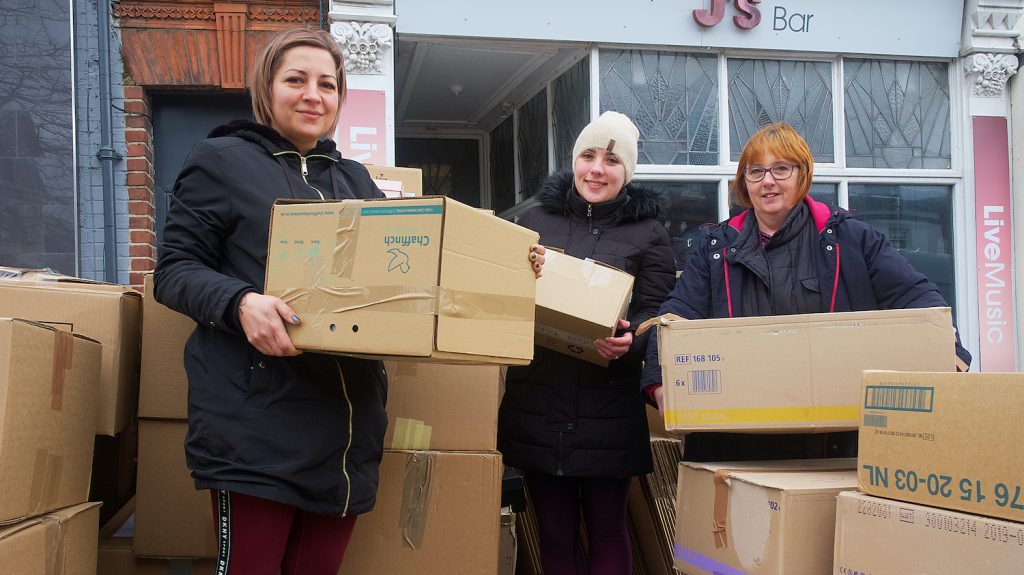
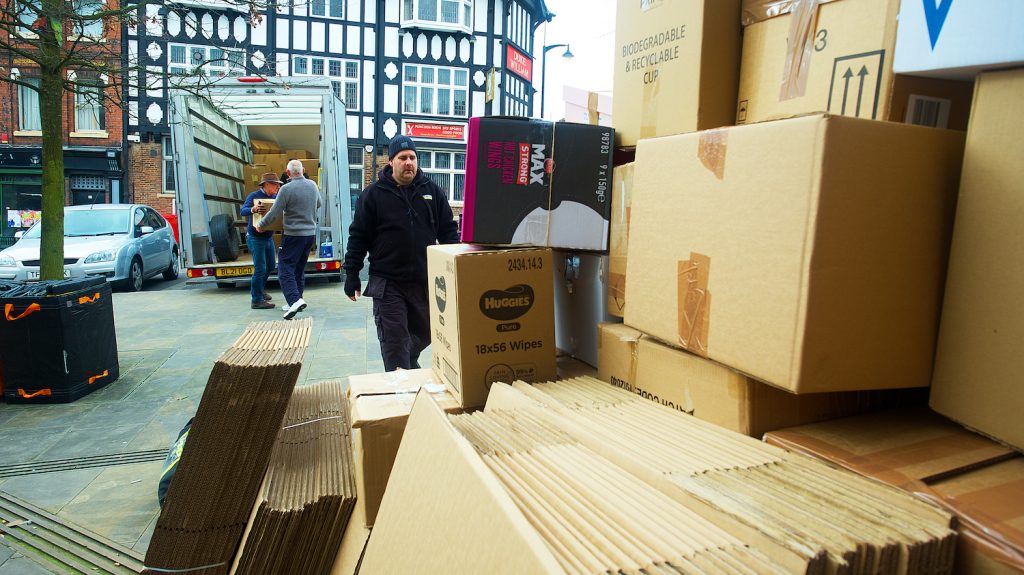
“This is probably van number 20. We’ve sent some vans already to Poland, and then we have a lorry going out to Poland on Wednesday morning,” said Agie.
Agie and Katie are restaurateurs. They run a Polish restaurant, which bears their name, in Burslem, Stoke-on-Trent.
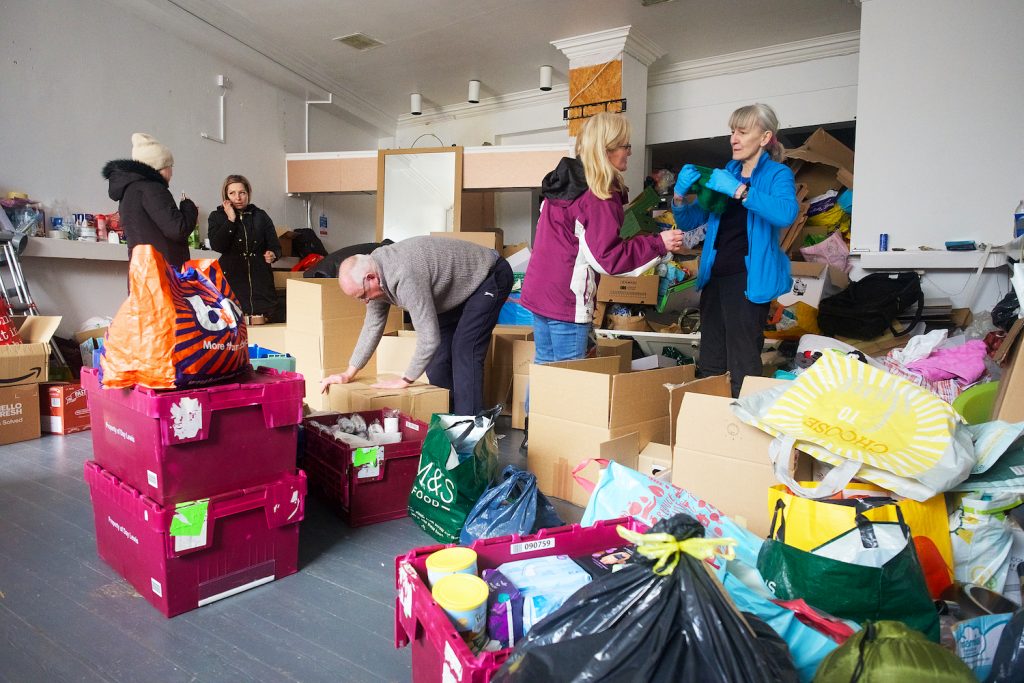
For the last week, in addition to their work at the restaurant, they’ve also been co-ordinating the collection and delivery of items donated locally to help Ukrainian refugees arriving in Poland.
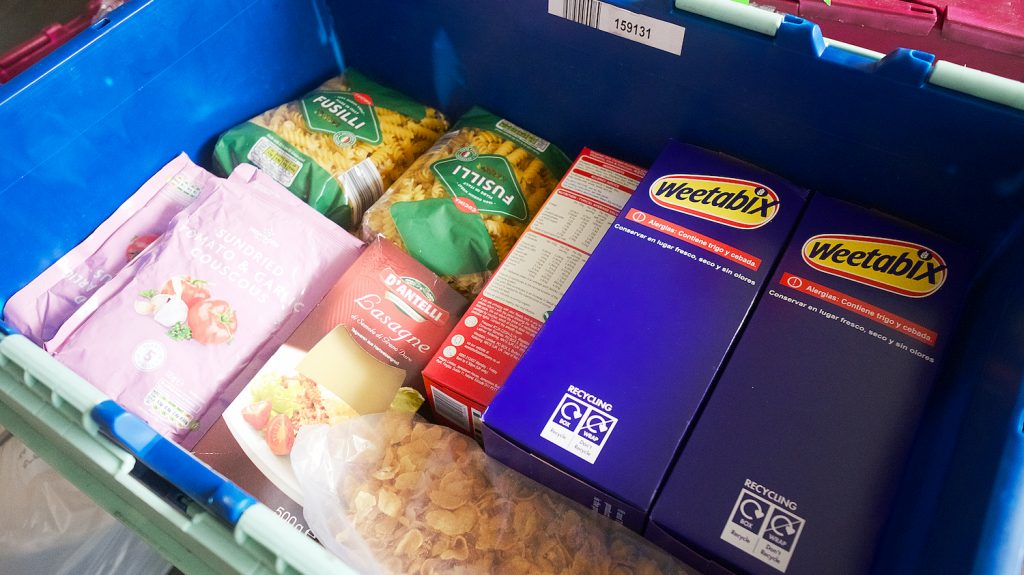
“The most important items are baby food, nappies, wet wipes, and then also dry food like instant soup so you can pour the water on it, and canned food as well, but nothing with meat because of the Brexit. We can’t send any meat from UK,” said Agie.
The girls started with a small act of kindness, collecting a few boxes of essential items to send to a Ukrainian family which Katie has allowed to use her empty flat in Poland.
A week later, fuelled by their eagerness to do something and the generosity of others, Agie and Katie are flat out but undaunted by the logistics of their mammoth project.
They are enjoying the support of a team of energetic helpers too.
“We have fantastic volunteers,” said Agie. “Without those volunteers, we can’t do anything really. These are our loyal customers. Wow. Yeah. The best customers really. They’re coming here every single day and helping us from 10 till 6 o’clock, even longer when we have to load the vans with heavy boxes. They’re always with us.”
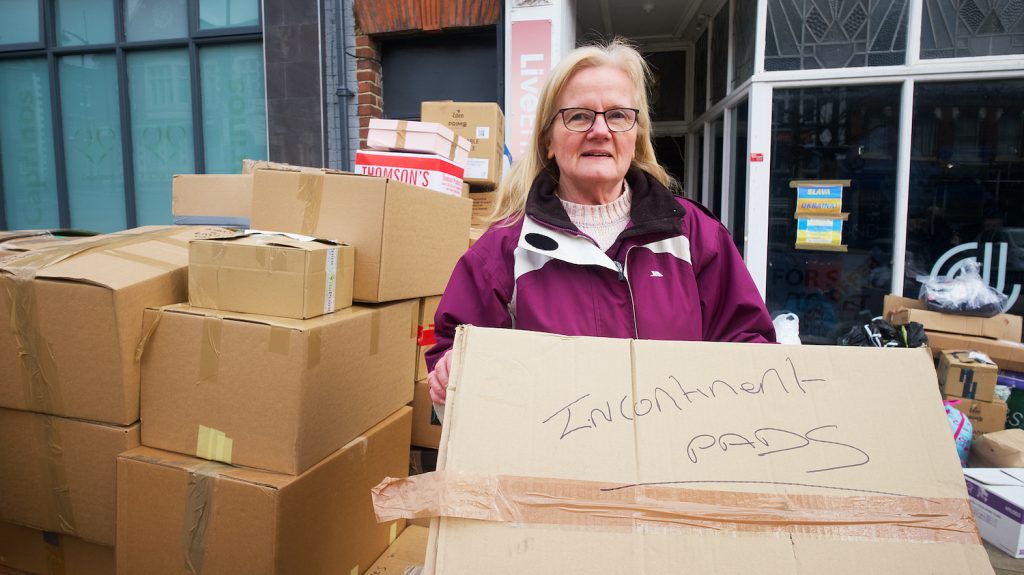
Judith is a retired army major and nurse. She’s been volunteering for the project for the last four days.
She said: “Like everyone else I’ve seen what’s going on and just needed to do something. I tend to help check on the medication and find out what we need
“Today I managed to get my brother to go round and collect incontinence pads. We’re getting lots of sanitary wear, but we also need incontinence pads.
“I just want to do my bit really. I intend coming in every day until it’s finished.”
With contacts in Poland, Agie and Katie have been able to direct donations to where they have heard there is a need.
Agie said: “We focus on some smaller cities where they are accepting refugees. So for example, we send a lorry on Wednesday to Zhepin, which is on the border with Germany. It’s a very small city, but they’ve accepted about 150 refugees already. And they struggle with the clothes, with the food, nappies, baby stuff for all those people.”
Katie added: “Tomorrow, 6 o’clock, we have one van who goes straight to Romania, because Romania needs help as well. Nobody thinks about that because it’s too far away. It’s something like 50 hours drive, and that road is not good. But then we found one guy who’s coming in tomorrow, 6 o’clock and he’s taking one van for free. That’s amazing. It’s something’s beautiful.”
Many people are turning off their TV sets, unable to cope with the constant stream of upsetting news and scenes. Even with their army of volunteers, one cannot help but wonder how long Agie and Katie’s energy can hold out. And what toll is this project is having on their spirit, and even their business?
Katie said: “I said to my partner, I need to reset my head because sometimes it’s too much. Our phones ring every single minute. Yesterday we had a few hours to reset a bit.
“When I wake up in the morning we have hope when we turn on TV that it will be finished. But it’s not.”
Agie said: “We’re exhausted. When we close the drop-off point about 6 o’clock we go into the kitchen and then we work as a chefs. We’re going back home about 10, 11, and exhausted.
“We hope to send two or three more lorries and then we think it’s going be enough for now. Obviously if we have donations or if we have people willing to help, we can sort that out. But that’s a big scale.
“We’re working every single day from early morning until very late at night.
“We can’t do much longer than a few days. Yeah.”
Right now it’s important that only the most needed items are donated. Efforts have to be focused and targeted, or the girls and their project will be swamped.
Agie explained: “If we send a lorry full of clothes it’s a waste of space, waste of resources, waste of money, really, because we could send nappies, a lot of dry food, cans, sleeping bags. This is what people really need the most.”
Of course, the project is still receiving items that can’t readily be sent to Poland or elsewhere. Nothing, however, is going to waste. Other local projects are also benefitting and helping out.
Lydia Palmer is from Rehoboth Community Project. This project is taking in the items that cannot be sent elsewhere.
Lydia said: “We’ve been bringing donations up, and we can help to take things away as well. We work with many agencies, as well as adult social services. We also work with Stoke homeless. We work with other charities for refugees and asylum seekers.”
There’s no doubt that Agie, Katie, and the volunteers, are feeling rewarded for their incredible efforts.
“The nicest point of this is when we receive photos from the drivers,” said Agie.
“When they arrive into the drop-off point in Poland, sending us photos, how they’re unloading the donations. We know they have been received and they’re in the right place to be.
“When we’ve sent big vans, and they send us a photo saying ‘Yes, we received. Yeah. We’ve got everything you’ve sent’ it’s heartwarming.”
It is heartwarming.
Despite the evil we see playing out on our televisions, Agie, Katie, and their team of volunteers are proof that the world still has a determination to do the right thing, and an abundance of kindness and love. These will prevail.
“I think there’s something about that when you really lean in to the form you’re working in, be that a website or be that an audio piece, and you bring your theatricality to that, I think really exciting things can happen.” Ruby Thompson, Artistic Director, The Herd theatre company, Hull, UK.
Ruby is Artistic Director of The Herd, a theatre company in Hull, in the north of England.
The Herd have been collaborating with Stand and Be Counted, another theatre company, based in Bradford, also in the north of England.
Together, the two companies have created an audio walk adventure called Hidden Winter.
Hidden Winter follows 8-year-old Hiba, a mischievous cat, and a trail of winter clothes in a story celebrating the joys and difficulties of making friends in a new place.
PODCAST: 35 minutes
In this podcast, the creative team behind Hidden Winter audio adventure, tell me about the joys and difficulties of adapting their theatre and storytelling skills to reach audiences during the pandemic’s lockdowns and restrictions.
It’s a process that’s presented lots of opportunities for learning new skills, and for doing theatre in a different way.
My guests are:
Ruby Thompson, Artistic Director of The Herd.
Rosie MacPherson, Artistic Director of Stand and Be Counted,
and Firas Chihi, narrator and translator of Hidden Winter.
“We can’t stop engaging with our participants. We can’t stop the work that we do. We are a point of support. So to be able to make work with participants, that they can see is definitely going to happen and have a life, has been really important and crucial in keeping things going.” Rosie MacPherson, Stand and Be Counted theatre company, Bradford.
This week I visited a useful little project that might just have big impacts on our future. One that can help us to reduce the stresses we’re putting on the planet, as well as reducing the stresses we put on our own pockets.
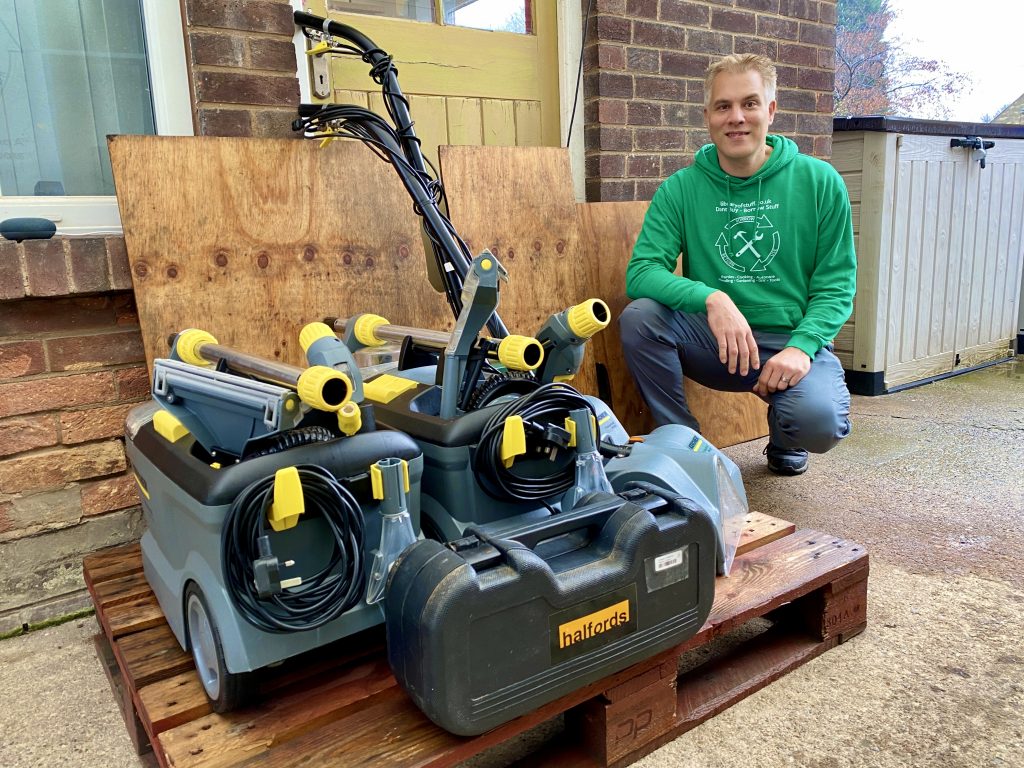
It’s called the Hull Library of Stuff, and its Director is Alan Dalgairns.
I love gadgets, right? When I was 12, I had a study, and I used to fix things for people. It was under the stairs. It was right next to a gas meter. I used to drive my mum up the wall by taking things apart because I always wanted to know how they worked, sometimes I put it back together, not always! I used to have friends who used to bring round broken toasters and I used to fix them and then give them back. Yeah, I love gadgets and I love taking things apart, so this is perfect,” said Alan Dalgairns.
Alan is the founder of the Hull Library of Stuff, a project which opened its doors in March this year. The Library of Stuff is a an organisation that lends things to people.
PODCAST: 12 minutes
“Think of it as like a book library, but actually we do everything other than books. So there’s all sorts of equipment, DIY equipment cleaning equipment, hobby equipment, all sorts of stuff,” said Alan.
The seeds of the idea for this project were planted as far back as 2006, when Alan bought an item off eBay to do a task.
“It was a film scanner for scanning negatives and slides, to scan all my dad’s old slides. When I finished with it I put it back on eBay and sold it again, and I sold it for the same price I bought it for. I thought, ‘Oh, I wonder how many people have bought this before me?’ In those days you could go on eBay and have a look. I went back six people, and I thought ‘they’re basically borrowing it’”, said Alan.
Alan had identified a trend. In essence, people were using an auction site to borrow items for a short time to complete one-off tasks, with all the added hassle of posting and packaging the tools they were purchasing and returning. He knew there must be a more efficient way of meeting people’s needs.
“Then I found the library of things movement,” said Alan. “It’s actually a movement that started in America in around the 1970s. So there was one in California in about 73, something like that. It opened to share tools, it was a tool library.”
The Hull Library of Stuff, which is situated on Cottingham Road, now has 300 members, and has so far lent 260 items.
Alan explained: “It’s getting people to notice that there is a different way of doing things. What we’ve done is we’ve made this available online. It’s like an online catalog. It’s like going to Argos. You can go online, you can look for an item, you join for a £1, and then you can book it out for a full week. You pay a small fee to book it out. Then, if after a week you still need it, you can extend it for another week, if it’s available. So the plan is that we have a store of equipment that people can borrow without having to physically buy it.”
The project has two clear aims, Alan explained.
Firstly, the Hull Library of Stuff helps people to save money, avoiding expensive purchases and hire costs.
“One of the things that I have done is aimed this at people who haven’t got money, who haven’t got the ability to buy these things anyway. So we aimed our pricing specifically at people who can’t afford to buy these things, but they could borrow it for a week and do the job.
“I don’t want people to be getting into poverty or getting into money troubles because they they’ve bought something that they can’t afford.
“We’ve had someone who was going to buy a jet washer on hire purchase because they couldn’t afford one. And they came and borrowed ours, it was £13 pound for a week and they managed to get the job done doing that,” said Alan.
Another example of an item people can borrow, helping them to save money, is the library’s ‘car computer’, a diagnostics tool which identifies the problem behind a dashboard warning light, maybe allowing the car’s owner to fix an issue themselves.
The second mission aim of the Hull Library of Stuff is to help reduce the environmental impacts of manufacturing, owning, and disposing of ‘stuff’.
Many of us own cheap power tools that we rarely use, they just sit on a shelf in the garage.
Alan shared some alarming data about these little-used tools.
He said: “There was some research done recently that suggested that a DIY power drill only gets used for thirteen minutes of its entire life, thirteen. So the rest of the time it’s sat in storage. So you think about all of the garages in the whole world and how many tools are sat there that are not being utilised 99% of the time.
“And that power tool was probably designed to be used for 15 minutes as well. That’s the problem, they’ve got to a point where they can produce something very cheaply, and people can get access to stuff really cheaply, but the problem is that they’re not designed to last a long time. So what happens is, rather than someone selling it on when they’re finished with it, it ends up in the skip. There’s batteries, lithium batteries, and all of that type of stuff that you’ve got to deal with as special waste as well.”
The Hull Library of Stuff is open for two days each week for borrowers to pick up and return items – Tuesday and Wednesday, 10am to 7pm. Items can be browsed and booked online throughout the week.
The range of items available to borrowers is wide and growing.
“We’ve got disco equipment, we’ve got a small disco set-up, which is perfect for a house or a small hall. You can borrow a smoke machine as well, if you want to give it the full effect. I’ve got fishing gear, if you want to go and do some fishing. I’ve got laminators. I’ve got a load of film and photography equipment to convert old analog stuff to digital. Lots of DIY equipment. I’ve got a a cement mixer that will fit in a car. We’ve got a compactor, an electric compactor. A rotavator, quite a bit of gardening equipment as well as DIY equipment,” said Alan.
The library’s commercial carpet cleaners are among the most popular items borrowed.
“I went and hired one and did some market research and then bought a really good one. So we’ve got two of them now.
“I’ve just actually shared my top 30 items to another library with the prices we charge, to try and help another library out,” Alan added.
Safety, of course, is a key focus for Alan, as items are booked by borrowers.
“You don’t want to give someone a chainsaw that they’ve never used before and just pop it over the desk and go ‘see you later’. What we’ve done is we’ve got a list of what we class as dangerous items. We do a risk assessment and then decide whether something should be on the dangerous item list or not. If it is, if someone wants to borrow it, they have to spend 15 minutes with us going through a risk assessment,” Alan explained, adding that he’s always happy to advice borrowers on the right tool for the job, and how to use them.
The Hull Library of Stuff is a useful little project, with big plans for the future. It’s projects like this that will help us all to reduce our impact on the planet, as well as reducing impacts on our pockets.
Alan said: “If we can all use one central pot of things, rather than all having our own version of those things, there’ll be less demand, fewer things created. That will reduce the impact of climate change.”
A conversation between an uncle and his nephew around a red ribbon turns into a candid discussion about what it means to be HIV positive and how attitudes and science have changed in the last thirty years.
PODCAST: 12 minutes
CAST AND CREW
Uncle Collin: Andy Train
Matt: Jerome Denton
Written by Josh Whittingham
Produced by Jerome Whittingham
Music: “Overdrive” by Corbyn Kites Zapslat.com
Additional sounds: Youtube Audio Library
Produced for Trade Sexual Health, Leicester, for World AIDS Day 2020
Whilst many of us are looking forward to getting back to some sort of normal life, a small number of service users at one city support project may be sad to see some lockdown measures eased.
Humbercare’s ‘Self Enablement Service’ (SES) provides intensive support to individuals with complex needs, helping them to beat social isolation and to be actively involved in their neighbourhoods. The project delivers personally-tailored help to clients in various household settings, including one-to-one, 24-hour, live-in support in clients’ own homes.
Cassy Lawson is Manager for Humbercare’s Self Enablement Service.
She said: “Some of our service users are autistic. They don’t like crowded places. They don’t like being encouraged to socialise anyway. They are really enjoying lockdown. They’re happy that you can go into a shop and you’ve got to keep distanced. Everything is less busy, and presented in a much more structured way. They’re really thriving in this situation.”
The lockdown has presented a unique challenge for all of us and not surprisingly many of the people we help feel frustrated at being forced to stay at home.
Supporting other service users, especially those with acute learning difficulties, has been particularly difficult for the project during lockdown though.
Cassy explained: “We support a client group who have diverse and complex needs, many of whom would otherwise be detained in restrictive settings such as specialist psychiatric units. The Self-Enablement Service, in line with Humbercare’s ethos, works to ensure that each person meets their full potential to live as independently as possible within the community.”
“It’s been very difficult, yes, because our service is very hands-on, in people’s flats, cooking tea with them, making beds. I’d say it was even more difficult for the staff in the first instance, not being able to provide the type of support that we usually would. But we’ve never stopped working, we continue to go and support them, we’re just having to do a lot at the door now,” said Cassy.
“In the 24-hour support settings, we still go in as usual. People still need our support, we can’t stop that, we’re just taking appropriate measures. We’re using a lot of visual prompts. We’re taking in a 2m tape, so they can see what constitutes 2 metres distancing. We’ve got visual reminders and signs of the symptoms of coronavirus, and what to do if you do have any symptoms. These changes have help people understand the parameters they must live with and has helped understanding just what the changes mean.
“The main challenge we’ve had over the last few months is trying to get service users to understand lockdown, to take it seriously, and not to take it personally – that it’s not targeted at them as individuals. We hadn’t anticipated that some would feel victimised by the situation. We’ve had to constantly explain that ‘we’re all in this together’.”
“I think it’s interesting that what might be difficult and different for one person is easy and comfortable for another; we are learning all the time and meeting particular and individualised needs, so in some way this has developed our best practice.”
The Self Enablement Service focuses on service-user’s time, showing them how to use their time meaningfully to distract them away from negative activities. Many SES clients rely on having a full timetable to occupy their days in a positive way. Lockdown has turned this approach completely on its head.
Cassy said: “A huge part of our support is engaging people with all of the great activities we have in Hull, and all of the great clubs: Men in Sheds, Jubilee Life College, all those fab opportunities. For some of our service users, that’s their life-line, for socialising, meeting other people, just keeping them out of trouble. But all of that has been closed, and people just don’t have anything to do with their days. That has been the biggest impact, as we have been the only source of distraction as all their support networks and daytime activities have completely stopped.”
In many cases, the service users have taken the initiative to create activities for themselves and their peers, particularly in group accommodation settings. They’ve been cooking, sharing recipe ideas, and crafting together. The pressures of lockdown, and the dangers the coronavirus presents, have shown people just how important it is to support others, and many service users have responded well to opportunities to learn new social skills.
“This has been extremely valuable in showing our service users just how inventive and caring they can be in what has been at times very difficult and frightening times,” said Cassy.
SES staff too have embraced new learning opportunities.
Cassy explained: “Video conferencing, yes, all our staff meetings are now on Zoom. That’s really helped us to keep in contact with staff that are out in the community. The community-based team, who are on shifts, we struggled to get them together before, people work nights, people work days, they’re all over Hull and the East Riding. So now we keep in touch by video call, that’s been fab. We’ve also been video calling some of our service users as well.”
Just before lockdown began, the Care Quality Commission visited Humbercare’s Self Enablement Service, to carry out a periodic inspection of the project. SES maintained its ‘Good’ rating across all aspects inspected: Safe, Effective, Caring, Responsive, and Well Led.
Cassy concluded: “We never take our foot off the gas. We’ve been going now for five years, and at no point do we ever say ‘we’re done’. We get new service users, we have to learn new things. We get new staff that are constantly teaching us new ways to do things. I was kind of looking forward to being able to show SES off, to be honest. I do quite enjoy the inspections.”
“Reflecting over the past two months I think we have all had to learn new ways of living, working and caring for each other, and the lockdown has provided an opportunity for us all to grow together.”
Experienced business owners are being encouraged to volunteer to support Hull’s fledgeling entrepreneurs.
Enterprise is really difficult for many businesses just now. Some cannot operate due to lockdown and social distancing measures, others are seeing greatly reduced revenue as households review their outgoings during a time of financial insecurity. Few business plans will have prepared for the impact of a global pandemic.
Young entrepreneurs, without their own business experience to guide them, are in particular need of support.
Charles Cracknell, Hull City Council’s Youth Enterprise Manager, says: “We are now into our eighth week of the current Covid-19 lockdown. We are working with 225 young people aged 16 to 29 who are current and past participants of the ‘Making Changes for Careers’ programme, and/or the John Cracknell Youth Enterprise Bank.
“Many of the young people we are supporting have only just come off Universal Credit and other benefits to set up in business or find work. They now find themselves, for a wide number of reasons, unable to trade or work, and unable to access the various schemes at the moment.
“We have now set up two schemes to support them. We’ve established a mentoring scheme with volunteers from across the UK, all willing to give help and support to our young entrepreneurs. So far 70 mentors have volunteered to give advice and support on aspects of how to run a business, help to find a job, or just be someone knowledgeable to chat to.”
Sue Cade, who runs a PR agency in Devon, has volunteered as a mentor.
Sue says: “I’ve run my own business for almost 30 years, and I am well aware of the vulnerability of working this way. When I found out that so many young people have missed out on Government help during the Covid-19 pandemic I was happy to offer my services as a mentor, specifically to give advice to some of the young entrepreneurs with making the best use of social media accounts for sales.
“Not helping young people who have shown a willingness to set up and run their own business has a long term cost to society. Though I live in Devon I am proud to be a mentor to support young people in Hull.”
Valerie Dwyer, Founder of My Wonderful Life Coach, is also offering her experience as a mentor.
Valerie says: “What could be more rewarding than bringing along a new generation of entrepreneurs? 30 years experience, 10 businesses, and three recessions behind me, I learned a thing or two about how to start, scale, survive and thrive.
“I am now delighted to be mentoring Jennifer, a young photographer in Hull, thanks to Hull City Council reaching out. A relative start-up, Jennifer’s natural talent ranks with the best! She will be a name to be reckoned with, now she is finding her direction! It’s a thrill to watch someone’s confidence and ability grow when you encourage them, and empower them to go for whatever they want to on their own terms!”
Complementing the valuable experience offered by business mentors, a Young Entrepreneurs Emergency Fund has been started, with initial financial support from the John Cracknell Youth Enterprise Bank, to help provide some financial stability to the city’s young start-up enterprises.
Donations to the grant fund are being collected via a GoFundMe page:
GoFundMe: JCYEB – Young Entrepreneurs Emergency Fund
The emergency fund has already received direct support from businesses, trade unions and charities, as well as individuals and young people who have previously been involved in youth enterprise activities in Hull.
To chat about how you can contribute your skills to these initiatives, contact Charles Cracknell, Youth Enterprise Manager at Hull City Council, on tel. 01482 505427, or email Charles.cracknell@hullcc.gov.uk